
Carbon Accounting Research Map
No research supports the current GHGP proposal; the majority does not see hourly matching as the best path to decarbonization

The energy transition is currently focused on Scope 2 changes - specifically, whether mandatory hourly matching (often referred to as 24/7 Carbon-Free Energy or CFE) should be a core part of carbon emissions accounting. To examine this discussion, we turn to evidence from the current research landscape. We conducted a comprehensive meta-analysis of available research including over 200 resources that explore carbon accounting changes and concepts. These resources were pulled from a pool of hourly matching advocates, critics, and many in between; including ScopeTrue, Emissions First Partnership, and more.
After excluding non-technical sources (blogs, op-eds, and news articles), we focused on over 50 white papers and 36 total academic papers, ranking them by rigor and sentiment toward the current GHGP-proposed mandatory hourly matching methodology.
When we apply a rigorous academic lens to the existing body of literature, a significant gap emerges: as the technical and academic rigor of a study increases, support for mandatory hourly matching declines.
Definitions
Rigor:
We categorized resources on a scale of 1 to 5 to distinguish between anecdotal evidence and scientifically validated research.
Informal media: Blogs, news articles, podcasts, and social media posts (excluded from core sentiment analysis).
Advocacy & regulatory: Regulatory filings, policy letters, and organizational advocacy documents.
White papers: Industry-standard technical reports and organizational position papers.
Technical research reports: Non-peer-reviewed published research papers with high-level analytical modeling.
Peer-reviewed papers: Academic papers published in scientific journals with rigorous blind review.
Sentiment:
We assessed sentiment based on whether the research supported the proposed hourly matching mandate or advocated for alternative frameworks.
No support: Either explicitly opposes mandated hourly matching, suggests "may not shall" language, and/or supports a different methodology.
Little support: Suggests changes or more research before mandating hourly matching, or highlights significant risks over benefits.
Neutral: Supports hourly matching only if another methodology like impact accounting is an equally viable option for Scope 2 accounting, calls for more research to be done before making a decision, or remains neutral.
Conditional support: Support is contingent on the "three pillars" (time, location, and additionality) being met simultaneously. Currently, the additionality pillar is excluded from the GHGP’s proposal.
Full Support: Full endorsement of the current mandatory hourly matching two-pillar proposal and the current policy trajectory.
In our findings below, sentiment rankings 1-3 are grouped as the “No support / Neutral” category, sentiment ranking 4 as “Conditional support”, and sentiment ranking 5 as “Full Support”.
Findings
No rigorous research supports the current GHGP proposal
No rigorous research supports the current GHGP proposal for two-pillar hourly matching. There are no sources with Rigor of 4 or 5 and Sentiment of 5, leaving the top right corner of Figure 1 empty. This is consistent with recent concerns voiced by some researchers and TWG members
67% of rigorous research does not see hourly matching as the best approach
67% of rigorous research does not see hourly matching as the best approach to further decarbonization, either favoring a different methodology (Sentiment 1 or 2) or calling for more research on all fronts (Sentiment 3). These papers argue that while the status quo is insufficient, the proposed hourly mandates may be a wrong turn for the energy transition.
33% of rigorous research supports a "three-pillars" approach
33% of rigorous research supports a "three-pillars" approach, with hourly matching, deliverability, and additionality. Crucially, the additionality pillar is not included in the proposed GHGP revisions. Further, three-pillar support is often contingent on widespread corporate adoption, which is not likely.
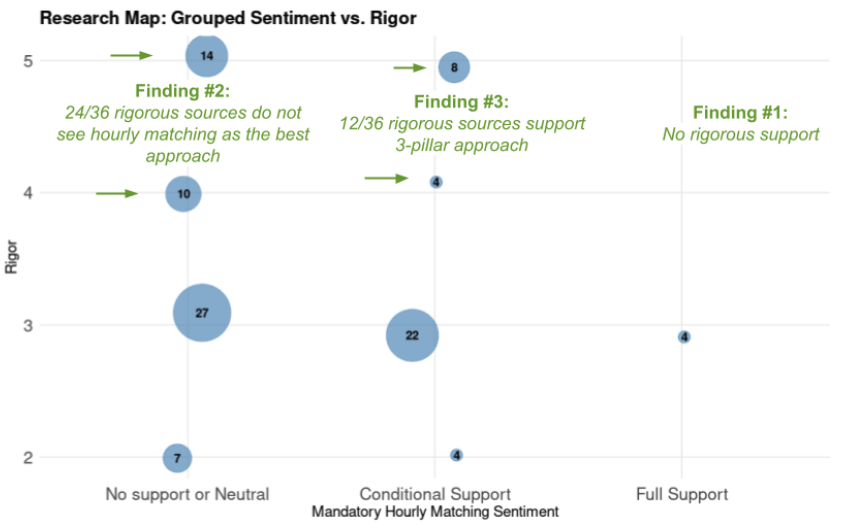
Figure 1: Resource rankings by rigor (y-axis) and position on mandatory hourly matching (x-axis)
Why doesn’t research support hourly matching?
The literature suggests that mandatory 24/7 matching may inadvertently stifle progress by focusing on timestamp synchronization rather than actual carbon displacement. Several high-rigor papers highlight that the current proposal ignores the causality of emissions. For instance, research from the University of Edinburgh argues that current Scope 2 revisions are often inconsistent with value-chain GHG accounting, suggesting a move toward consequential impact-based accounting instead.
Other highly rigorous papers suggest that forcing an hourly mandate could exclude smaller corporate actors due to prohibitive costs, fail to account for the marginal emissions of the grid (what is actually being displaced), and prioritize accounting wins over actual carbon impact.
What does the majority of research recommend to improve carbon accounting?
The research does not endorse the current 2015 Scope 2 guidance. On the contrary, the entirety of research we reviewed advocates for significant changes to current annual matching standards. However, the data suggests that mandatory hourly matching is not the most effective method to incentivize decarbonization.
Instead of rigid temporal matching, the high-rigor consensus points toward other options including consequential accounting (measuring the carbon actually displaced on the grid), quantifiable additionality (prioritizing investments that bring new clean energy to the grid), or flexible impact matching (encouraging procurement that targets high-emissions hours or locations without the full mandate of hourly matching).

Explore the research
While inherently subjective, this analysis is intended to be unbiased and fully transparent. All research sources considered, as well as the rigor and sentiment scores for each source, are available in the full dataset attached. If you see any errors or omissions in the data, please reach out to info@pragmaticcarbon.com